Gifts for Parents Who Have Everything: The One Gift That Isn't Stuff
Your parents don't want more things to dust. Pick one old print, restore it, print it, frame it. What it costs, how long it takes, and which photo to choose.
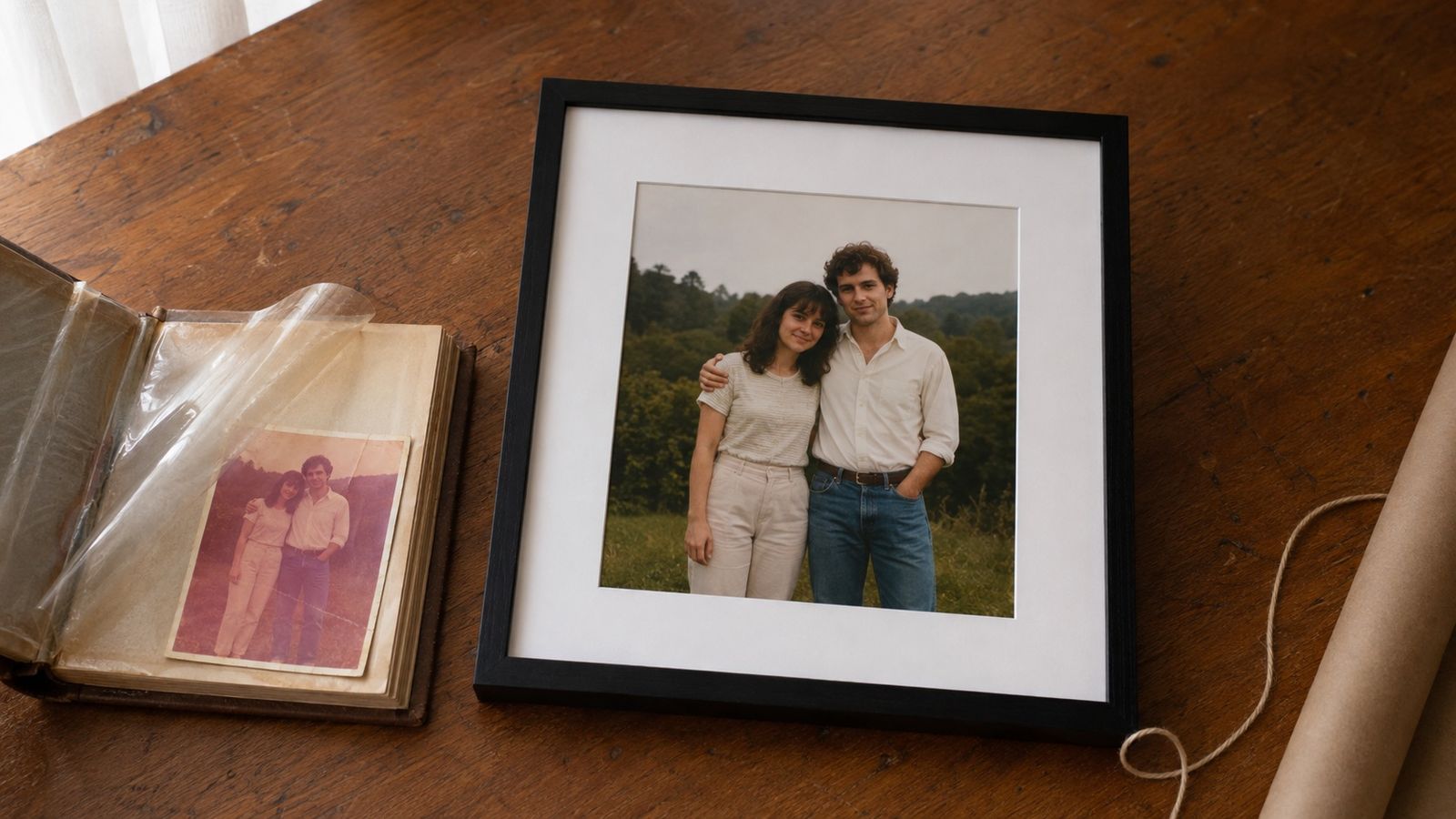
Somewhere in your parents' house there is a photograph from 1974 that has been turning orange since the day it was printed. It is in a shoebox, or folded into a church directory nobody has opened since the nineties. Restored, printed and framed, it is a better gift than anything on the list you are about to google, and if you already have the print it costs about forty dollars.
"Please don't buy me more things I need to dust." That is how one daughter on r/Gifts quoted her mother this April, while trying to choose between a photo book and a framed print. A restored photo of her own wedding is one of the few gifts that follows that instruction.
Quick answer: pick one old print that matters to them (their wedding, their childhood, a parent they lost), restore it free in about 30 seconds, print an 8x10 at a pharmacy counter, and put it in a frame. Same day is possible if you already have the print. Give it a month if you want custom framing.
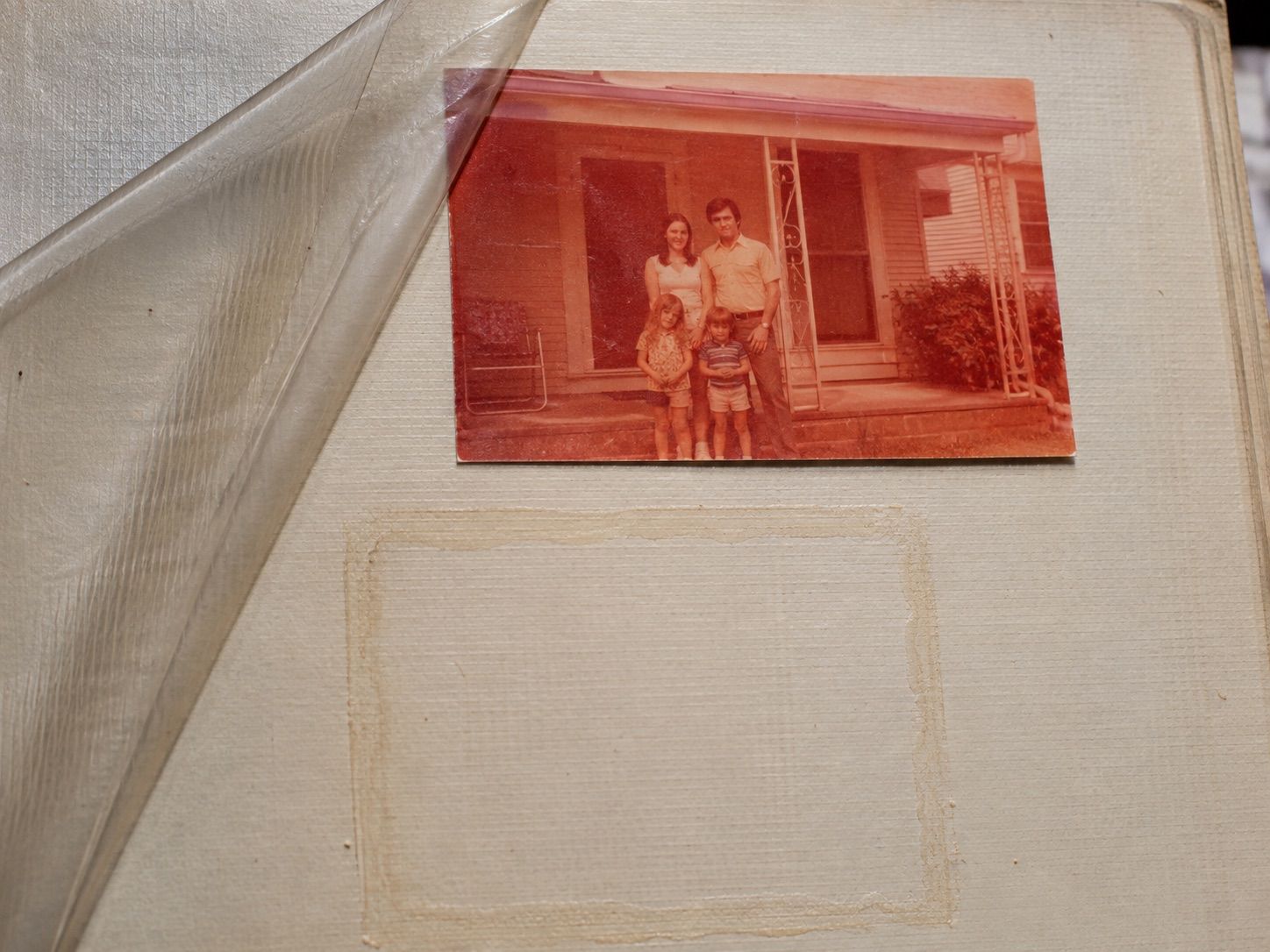
One more new thing gets a polite thank-you
Finder puts the bill for what the rest of us buy our parents anyway at $10.1 billion of unwanted gifts in a single Christmas. Your dad's third insulated mug is in that number, and he knows it. You half knew it at the checkout.
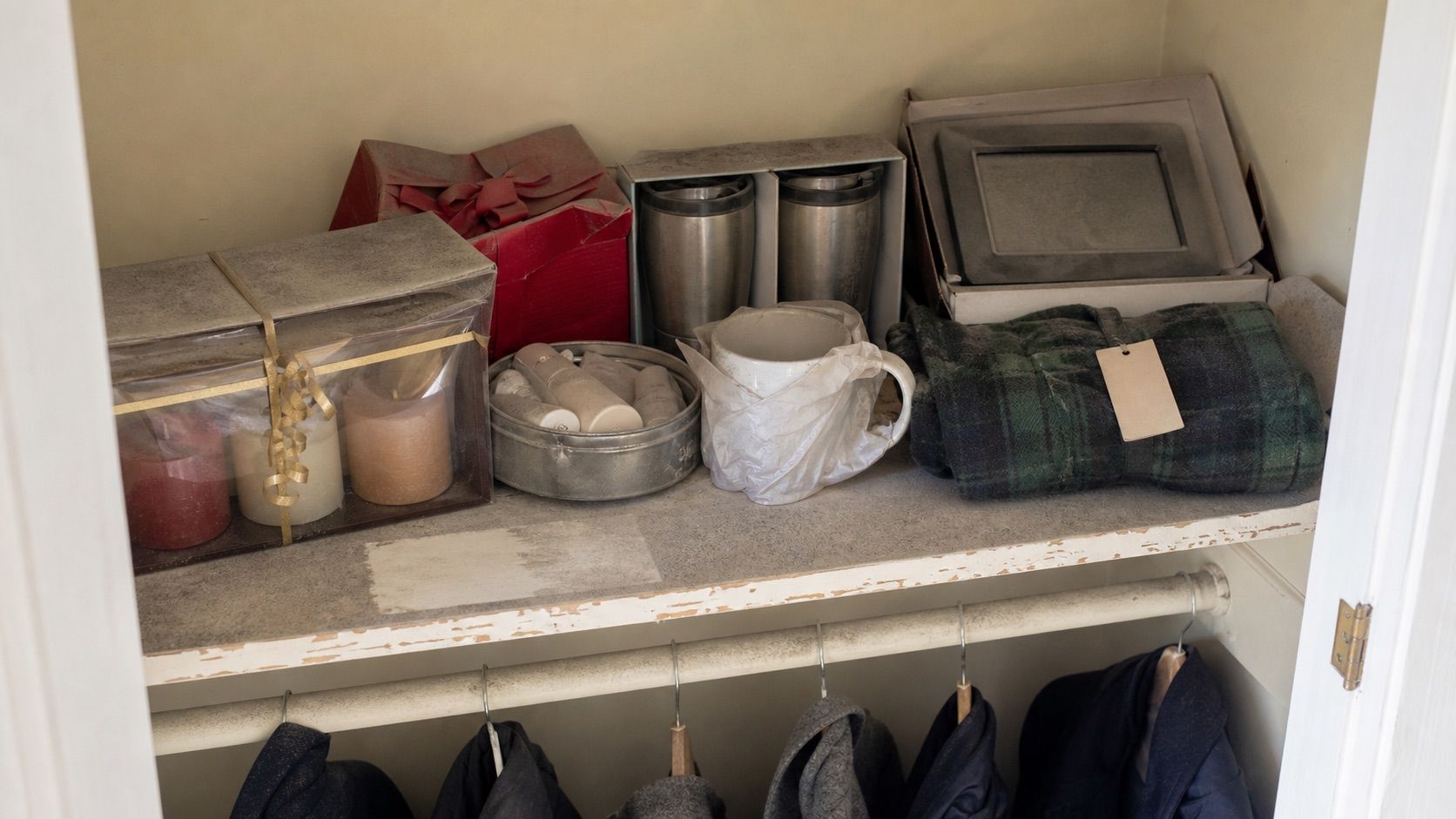
Last year it was the cashmere throw, or the coffee maker that grinds its own beans. They opened it, said it was lovely, and it went on the shelf next to the year before. The reaction you were picturing on the drive over never came, because they already own everything they use. Ask them directly and the answers get specific fast.
Further down the same thread: "No. More. Stuff." On r/Gifts a retiree wrote that if she wanted something she already had it, and that she was "seriously running out of places to accidentally leave these items." That is where the throw went.
What happens when they unwrap it
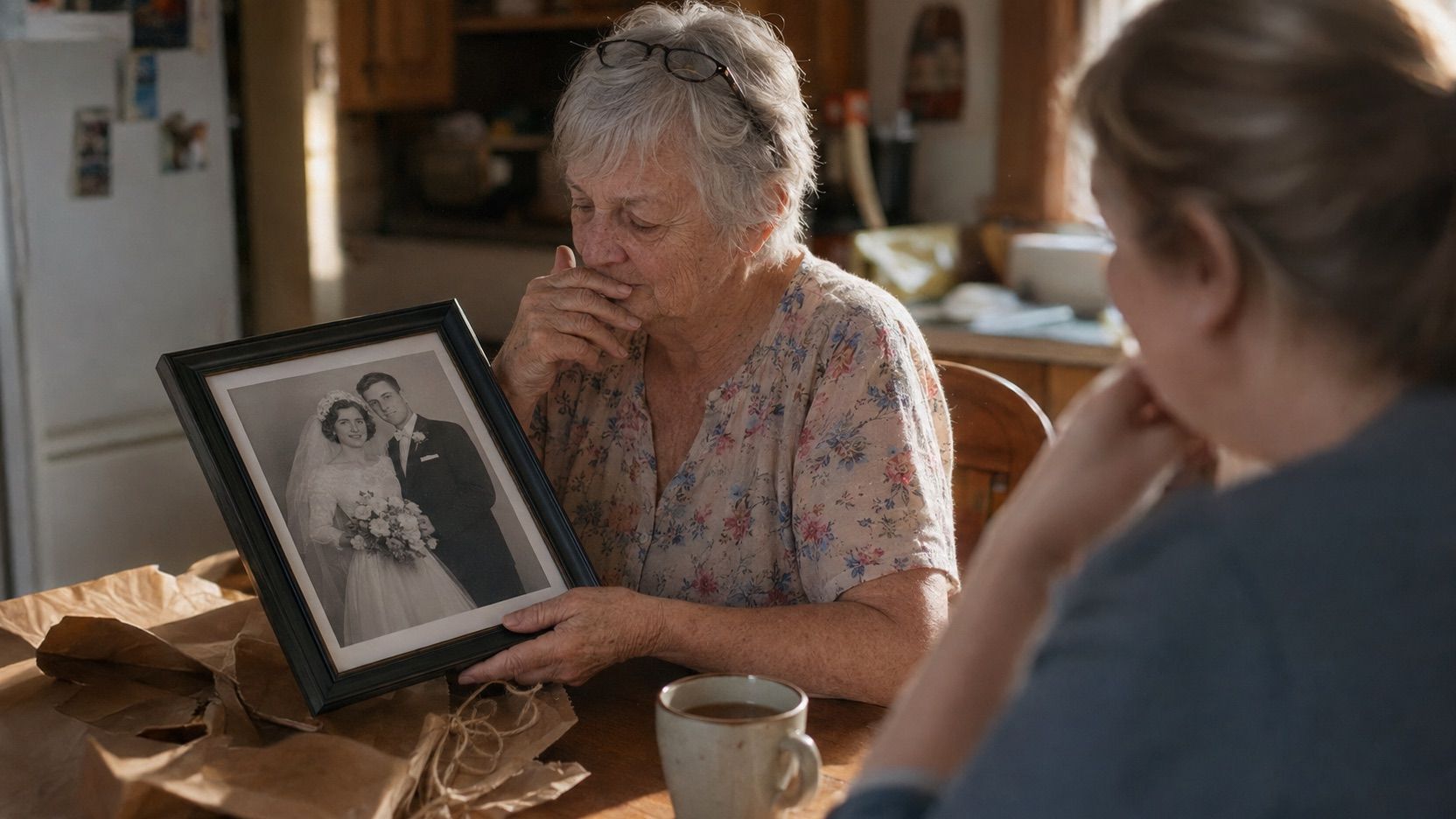
Wrap it and say nothing about what is inside. They tear the paper expecting another frame, and then the room goes quiet. Some cry, some laugh, and most start naming the people in the back row, including a few you have never heard of. That silence is the reaction the coffee maker never got.
What they are looking at is their own face on their wedding day, or their mother's, sharp for the first time in forty years. The software's share of that is about 30 seconds of pulling the orange out of a print that has been fading since the seventies, with the faces left where they were. The birthday requests on r/estoration skew old, and one was for a 93rd, for a woman 65 years into her marriage. Another poster had a grandmother's wedding photo colorized for her 80th, and the color was the whole point.
Then it stays out. The rest of what you have given them over the years is in the hall closet. This one goes on the counter and stays there, and your mother will have called your aunt about it before you are out of the driveway.
Six photos worth looking for, and where they usually are
Choose the photo before you touch a scanner. The ones that land show something your parents cannot see in person anymore.
| The photo | Why it works | Where it usually is |
|---|---|---|
| Their wedding photo | The version of themselves they still describe. Traditional for the 25th and 50th. | The framed one on the dresser has faded. The sharp copy is in the album, or with whichever sibling took the boxes. |
| Their own childhood | They get to be the kid again for a minute. | Grandparents' shoebox, now at an aunt's house. 1950s and 60s black-and-white holds up best. |
| The parent they lost | The one people cry over on r/estoration, week after week. | Often a single print exists. Ask siblings, check the funeral program. |
| The house they grew up in | The house is usually gone, or renovated past recognition. | The background of other photos. The local historical society. |
| The sibling group shot | Everyone in one frame, before anyone moved away. | Olan Mills or Sears portraits, and church directories: "1969 - 1979 - 1989," as one r/AskOldPeople commenter put it. |
| The photo they thought was lost | They already gave up on finding it. | The relative who moved. The cousin who scanned everything and never said. |
A genealogist on r/Genealogy emailed a distant cousin on a hunch: "Turns out he had scanned copies of ALL the letters ... He also had a photo of her." One email.
Even a single bad copy can be enough. A daughter whose father emigrated as a child with one grainy photocopy of his mother, who died in 1982 before they could reunite, had it restored, framed it, and handed it over wrapped without saying what it was. He pressed his forehead to it.
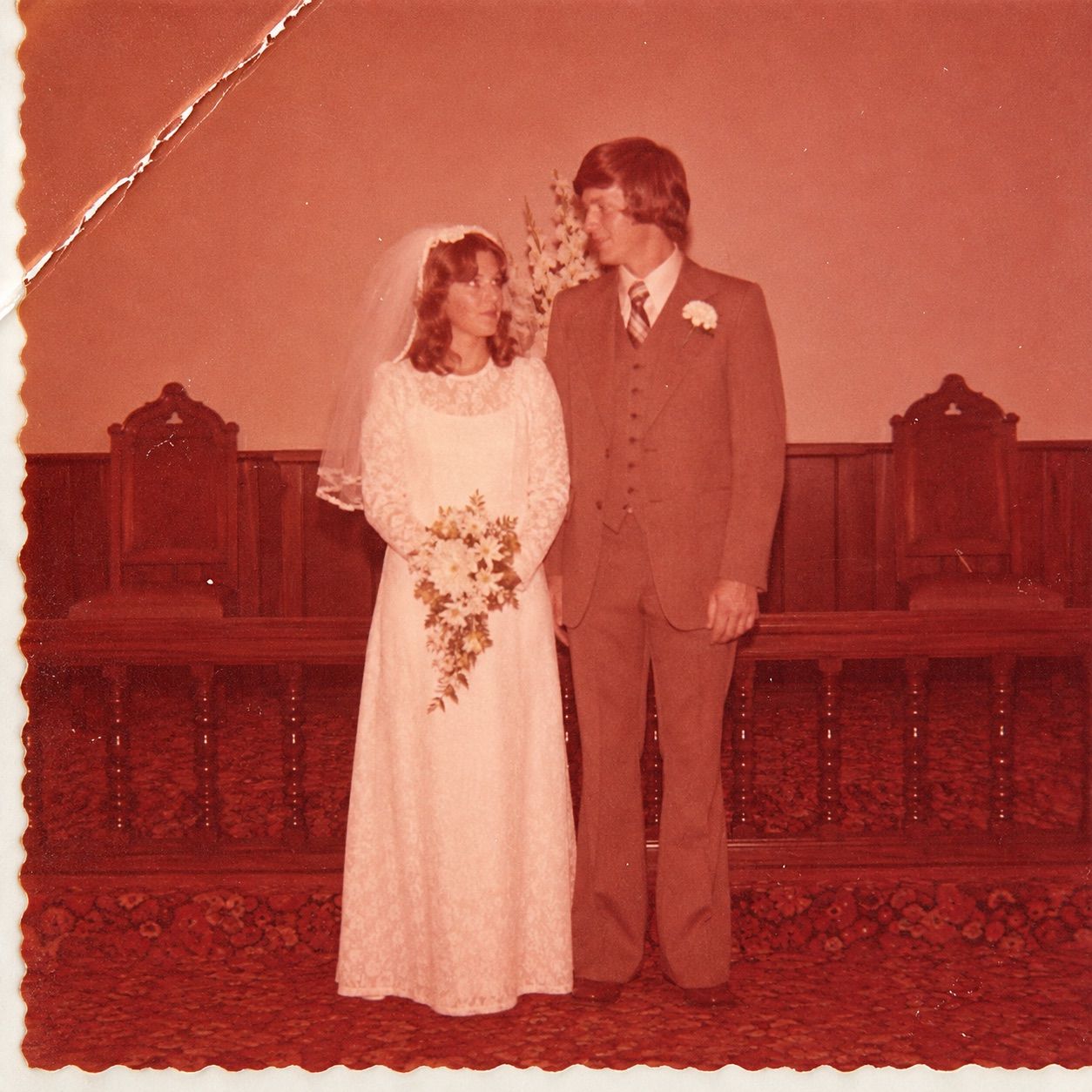 Before
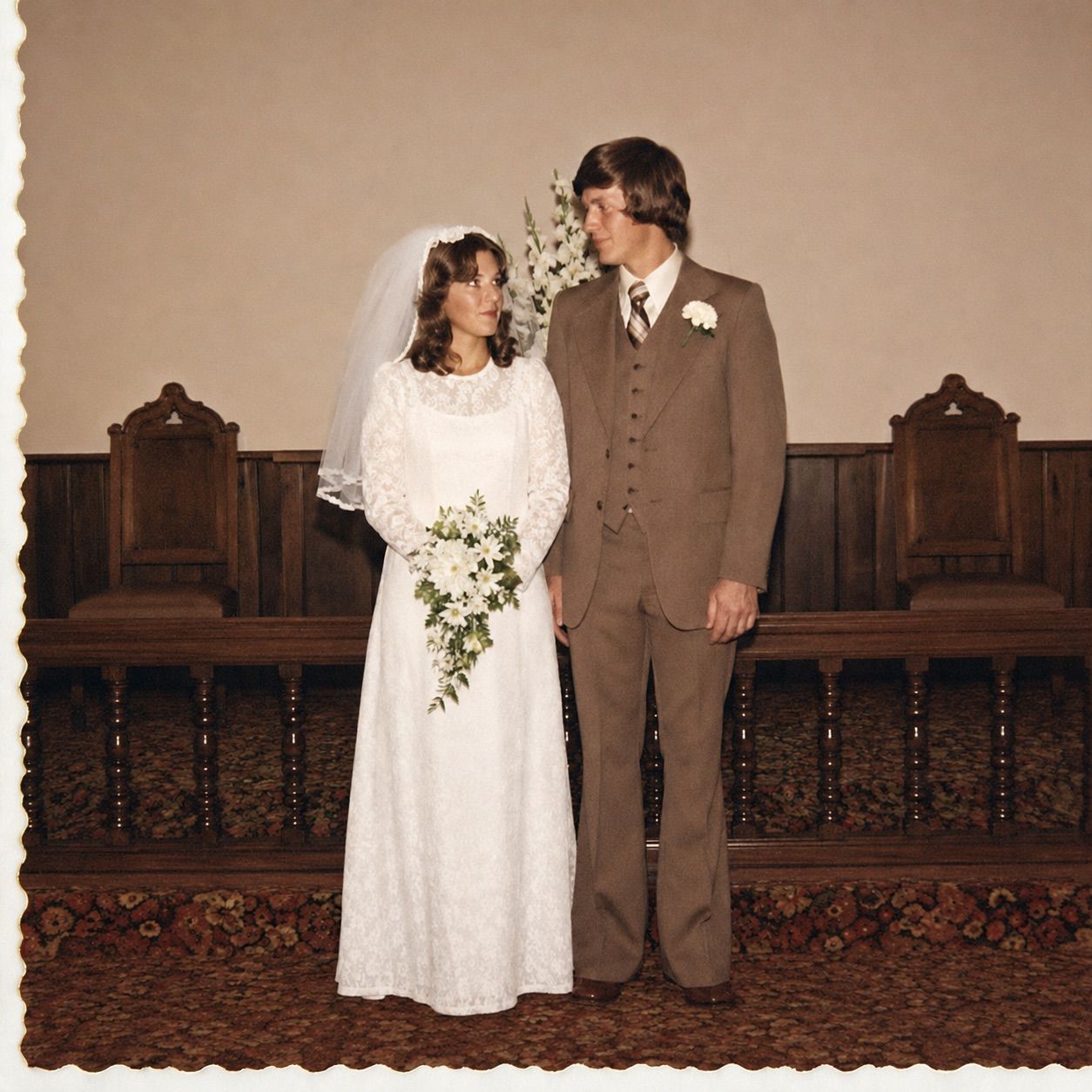 After
AfterA 1976 wedding print, 30 seconds apart. The orange is gone and so is the crease. Same faces, same pose, nothing invented.
The prints are still fading while you decide
The prints in that box were never built to last. Henry Wilhelm spent two decades testing color paper, and his verdict on the Kodak papers most American snapshots were printed on between 1971 and 1986 was that they "are doomed to steadily deteriorating color quality whether put on display or kept in an album in the dark." His predicted display life for an Ektacolor print on a home wall was a little over 12 years. Most of your parents' photos passed that mark before you finished school.
The direction of the damage tells you where the photo lived. Cyan dye dies first in the dark, so the box photos go red and orange. Magenta dies first in light, so the one on the wall goes green. A Polaroid has no negative behind it, so when the print yellows there is no backup anywhere.
The sticky "magnetic" albums that were everywhere in the 1980s bond to the print and leach PVC into it, which is why the National Archives tells families to get photos out of them.
How to turn a fading print into a framed gift
The restore itself is the fast part. Finding the photo and getting it framed eat up the calendar.
Find the sharpest copy. Not the one on display; light has been at it for decades. Check the album, then ask the sibling who took the boxes. A grandparent's duplicate is usually the least handled.
Scan it properly. 600 DPI for anything you might enlarge, 1,200 for a wallet print or a Polaroid. Save a TIFF or PNG and switch off the scanner's auto-fix. If the print is stuck in a magnetic album or to frame glass, scan it through the plastic or the glass; pulling it takes the emulsion with it.
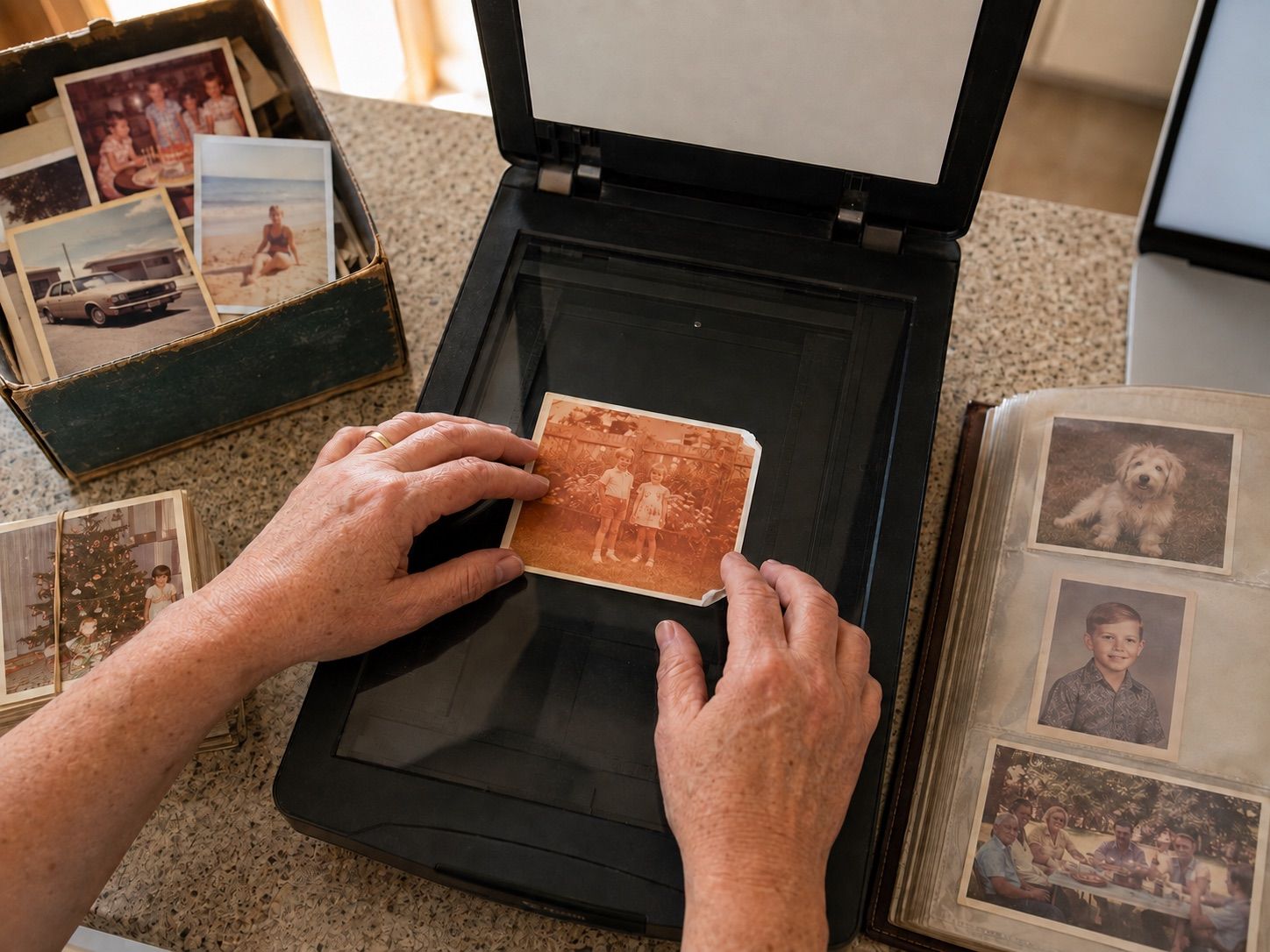
Restore it. Upload the scan to the free restore tool and wait about 30 seconds. Two a day are free with no account, but they carry a small watermark, so treat those as the test. A free account adds 20 credits, which is six to ten more without the watermark. If you are worried it changes too much, we tested that.
Decide on color, then upscale. Restore and colorize is the default mode, and on a black-and-white print that means the software is guessing at the dress and the wallpaper. For the grandmother's 80th above, the color was the whole point; plenty of families want the black-and-white they grew up with. Ask, or switch to Restore Only and give them both versions. Free restores come back at 1,024 pixels, which is thin for paper, so run the result through the upscaler at 2x before an 8x10; Starter plans and up go to 4x for 11x14 and bigger.
Print it locally. Walgreens prints an 8x10 for $4.49 with same-day pickup, and a mail-order lab is cheaper if you have a week. Ask for matte paper. Canvas makes it look like a decoration.
Frame it. A ready-made 16x20 frame matted to 11x14 is about $45 at Michaels, which also does 10-minute in-store framing for $29: an 8x10 printed, framed and gift-boxed while you wait. A local framer runs $110 to $250 and needs one to two weeks.
Hand it over with the original. The restored print goes in the frame; the original, untouched, goes in the same envelope. In pencil on the back of the new print, write who, where and the year. Then say nothing about what it is and let them unwrap it.
Prices are US retail as of September 2026.
Try it on the photo you already have
Upload the scan and see whether it still looks like them before you spend anything on paper.
How much time you actually need
If the print is already in your hand, this is a same-day gift. If it is in a sibling's basement, add two weeks to whichever row you are looking at.
| Time you have | What is realistic | Rough cost |
|---|---|---|
| This afternoon | Print in hand or a phone scan, AI restore, Walgreens 8x10 into a ready-made frame, or Michaels 10-minute framing | $35 to $50 |
| One week | 600 DPI scan, restore and upscale, 11x14 from a mail-order lab, matted ready-made frame | $50 to $80 |
| Three to four weeks | 1,200 DPI scan, AI restore plus a human retoucher for a torn print, 16x20, custom framing | $150 to $350 |
Where this goes wrong
- Mailing your only copy to a bulk scanning service on a deadline. They quote weeks after the box arrives, not days.
- Paying a stranger upfront with no sample. One r/estoration poster spent $47 on a "pretty disheartening" result.
- Throwing the originals out after scanning. The scan is a copy, and hard drives die faster than paper does.
The mistake that ruins the gift is the over-restore: skin like plastic, a jawline that belongs to someone else, a smile the software decided to improve. Your mother will notice in under a second. Run it more than once and pick the version that looks like her, not the sharpest one.
If the print is torn through a face, hand it to a human retoucher. If there are mold spots on top of the fading, read how to handle moldy photos before you scan; the spores spread to the rest of the box.
Start with the scan. The frame can wait.
Upload the photo tonight and see whether it still looks like them. If it does, the rest is a trip to the pharmacy.
Frequently asked questions
How much does it cost to restore an old photo?
With the free tool, the first two restorations each day cost nothing and take about 30 seconds. Professional restoration studios typically charge $50 to $200 or more per photo, and a badly torn portrait sits at the top of that range. Most gift photos only need the AI pass. Save the retoucher for a tear through a face.
Can a badly faded photo really be brought back?
The fading on the paper itself is permanent. Restoration works from the scan: it rebuilds contrast, pulls the color back toward neutral, and repairs scratches and creases. If most of the cyan is gone the result is an informed reconstruction, which is why you compare a few passes against your own memory of the face before you print anything.
What size should I print it?
An 8x10 in an 11x14 mat is the safe answer for a dresser or a shelf, and an 11x14 in a 16x20 frame for a wall. Bigger than that and a 1970s snapshot starts to show its grain no matter how good the restore is. Match the size to where they will put it, not to how much you love the photo.
What DPI should I scan an old photo at if I want to print it big?
300 DPI reprints at the original size. 600 DPI lets you roughly double it, so a 4x6 becomes a clean 8x12. Use 1,200 DPI for wallet prints, Polaroids, or anything headed for 16x20. Save the master as a TIFF or PNG and turn off the scanner's automatic enhancement.
Can I just take a picture of the photo with my phone?
For choosing between candidates and for a 5x7, yes. Google PhotoScan and Photomyne are free and remove most glare. For anything you plan to enlarge past 8x10, a phone shot is the weak link: uneven light, slight warping, and far fewer pixels than a flatbed at 600 DPI. A library or pharmacy print counter will scan a print for under a dollar.
My parents are downsizing. Isn't a framed print still stuff?
It is one object, and it replaces something already on a wall they own, which is not the same as a fifth candle. If they are clearing the house, the photo is the part of the box they were going to keep anyway. Penn State researchers found that people who photographed a sentimental object before donating it gave away 15 to 35 percent more. Once it is scanned and framed, the rest of the box can go.
Related guides and tools
How to Restore Old Photos: The Honest 2026 Guide
The full walkthrough, including what AI still gets wrong.
Do AI-Restored Photos Change Too Much?
Side-by-side tests, and how to keep the face you remember.
5 Reasons to Restore an Old Photo Before It Is Too Late
Memorials, reunions, genealogy, and how fast prints fade.
Free Image Upscaler
Take a restored scan up to print size before you order the 11x14.
Try it on one of your own photos
Most of our photo tools have a free version. Upload a picture and see what it does before you decide anything.