Tintype, Daguerreotype or Ambrotype? How to Tell
Tilt it: if it flashes like a mirror and turns negative, it's a daguerreotype. If a magnet sticks, it's a tintype. Dark-backed glass is an ambrotype.
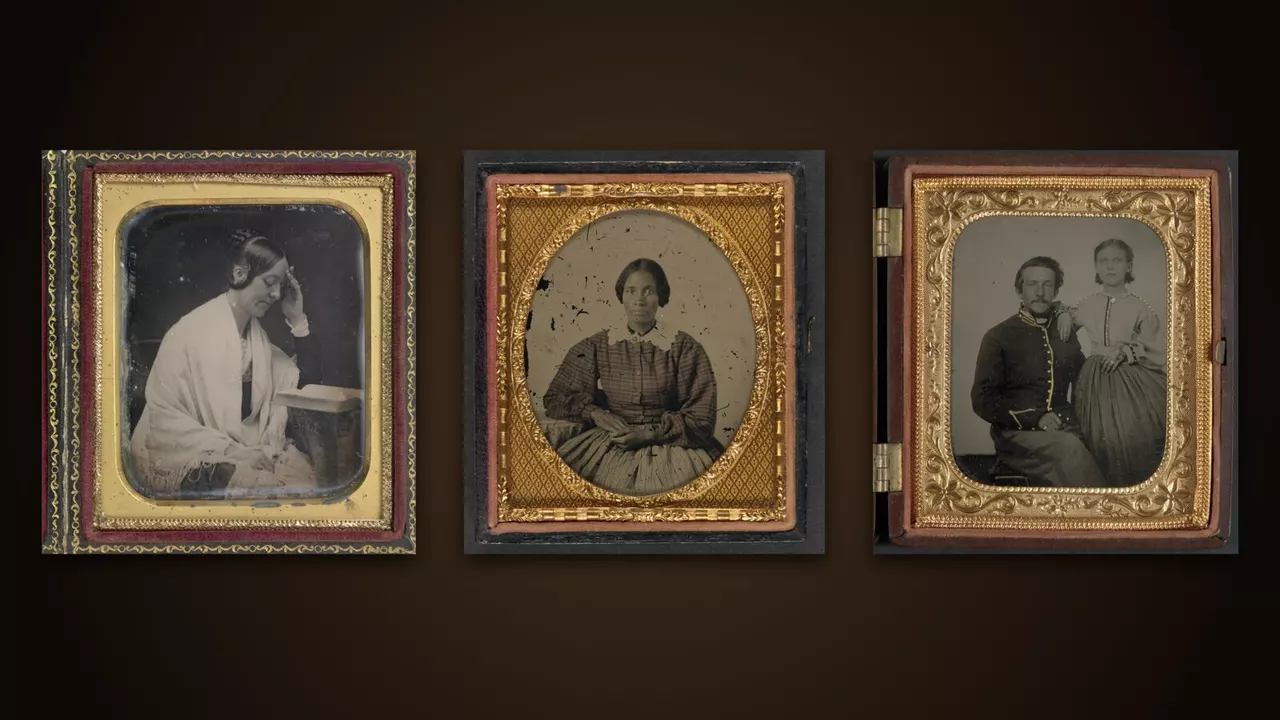
At the bottom of your great-grandmother's trunk there's a little leather case that opens like a book. Inside, behind glass and a gold frame, a woman looks out of a dark, shiny picture. Under it is a loose metal one of two people nobody can name.
Is it from the 1850s? Will it break? Can it go on the scanner? A lamp and a fridge magnet answer most of that, and the answer tells you how to handle it.
The short version
- 1. Tilt it under a lamp. If it flashes like a mirror and the picture flips to a negative, it's a daguerreotype.
- 2. Hold a magnet to it. If the magnet clings, it's a tintype: the plate is iron.
- 3. Neither? Then it's glass with a dark backing: an ambrotype.
Three kinds of one-of-a-kind photo
None of these can be reprinted. The plate in your hand is the very one that sat in the camera, so if it's lost, the picture is gone. The dates below come from the University of Illinois preservation guide and the Library of Congress.
Daguerreotype, 1839 to the 1860s. The earliest of the three. The picture is on a sheet of copper coated with polished silver, so it's literally a mirror. It almost always lives in a hinged case behind glass.
Ambrotype, 1854 to the 1880s. A cheaper picture on glass that pushed the daguerreotype out in the late 1850s. Most date from the mid-1850s to the mid-1860s. They usually sit in the same kind of case, which is why the two get mixed up.
Tintype, 1850s into the 1930s. A thin sheet of iron with a dark coating, in tones from chocolate brown to sepia. Tintypes were quick and cheap, so they outlived the other two by decades. That also means the plate alone won't date one closely; the clothes and the photographer's stamp will. You'll find them in cases, in paper sleeves or loose.
One more look-alike: a paper photo glued to a stiff card is a carte de visite (about 2½ by 4 inches) or a bigger cabinet card. Those are paper prints, and they scan like any other photo.
The tilt test and the magnet test
Sit under one lamp with the case open and the picture still in it. Tilt it slowly toward you and away.
A daguerreotype is a picture on a mirror. Depending on the angle, it shows a portrait, a ghostly negative, or mostly your own reflection. Nothing else in the family album does that.
A tintype's surface is only semi-glossy, so it looks much the same from every angle. Now the magnet. Tintypes are iron underneath, and a fridge magnet held to a loose one clings. Glass and copper won't hold a magnet at all. Through a case the pull is weaker, so a small strong magnet works best.
Cased, no mirror, no pull? It's glass. An ambrotype is really a pale negative that only looks right because of the black backing behind it, which is why the picture seems to float a little under the surface. If part of it looks like a negative, that's where the backing has flaked away.
Three things not to do
- 1Don't take it apart. Open the lid to look, but leave the picture in its frame. The case is just the box; the plate inside is sealed into its own little package, and that's what protects it.
- 2Don't wipe it. No cloth, no cotton swab, no glass cleaner, no fingertip. A dirty cover glass or a flaking plate is a job for a photo conservator.
- 3Don't put a daguerreotype on a flatbed. The scanner's light bounces straight off the mirror and you get a blown-out mess. Photograph it instead (below).
For a daguerreotype that seal matters most: the Illinois guide warns that opening it lets tarnish creep in from the edges, and never to take one out of its case without asking a conservator first. The National Park Service's care sheet is just as blunt about all three kinds: don't touch the image, and don't try to clean it.
Tintypes are tougher, but keep them flat and dry. Bending cracks the coating, and damp makes the iron rust.
Make one good copy, then put it away
Every time you handle the plate, you risk it. So handle it once: make one careful copy, and do all the fixing on that.
Daguerreotypes and cased ambrotypes: photograph them. Prop the open case flat, put your phone on a stand above it, and light it from low on both sides, not from above. Hold a black card with a hole for the lens under the phone, so the mirror reflects black instead of you. It's the same setup as our guide to photographing a photo without glare, just fussier.
Tintypes: a flatbed is fine. Their duller surface usually scans well. Lay a loose one inside a thin card frame so the metal never scrapes the glass, which is what digitizing specialists recommend.
Most are only a few inches across, so scan at 1,200 dpi, as you would any small photo. Then the original goes back in the box, somewhere cool and dry.
Fix the copy, not the plate
Don't be surprised when a tintype comes out of the scanner dark and flat. That's the plate, not your scanner: the Illinois guide describes most tintypes as underexposed and low in contrast.
This is where our photo restorer earns its keep. Choose “Restore only” to keep it black and white. Here it is on a cased portrait of a militia captain from about 1860:
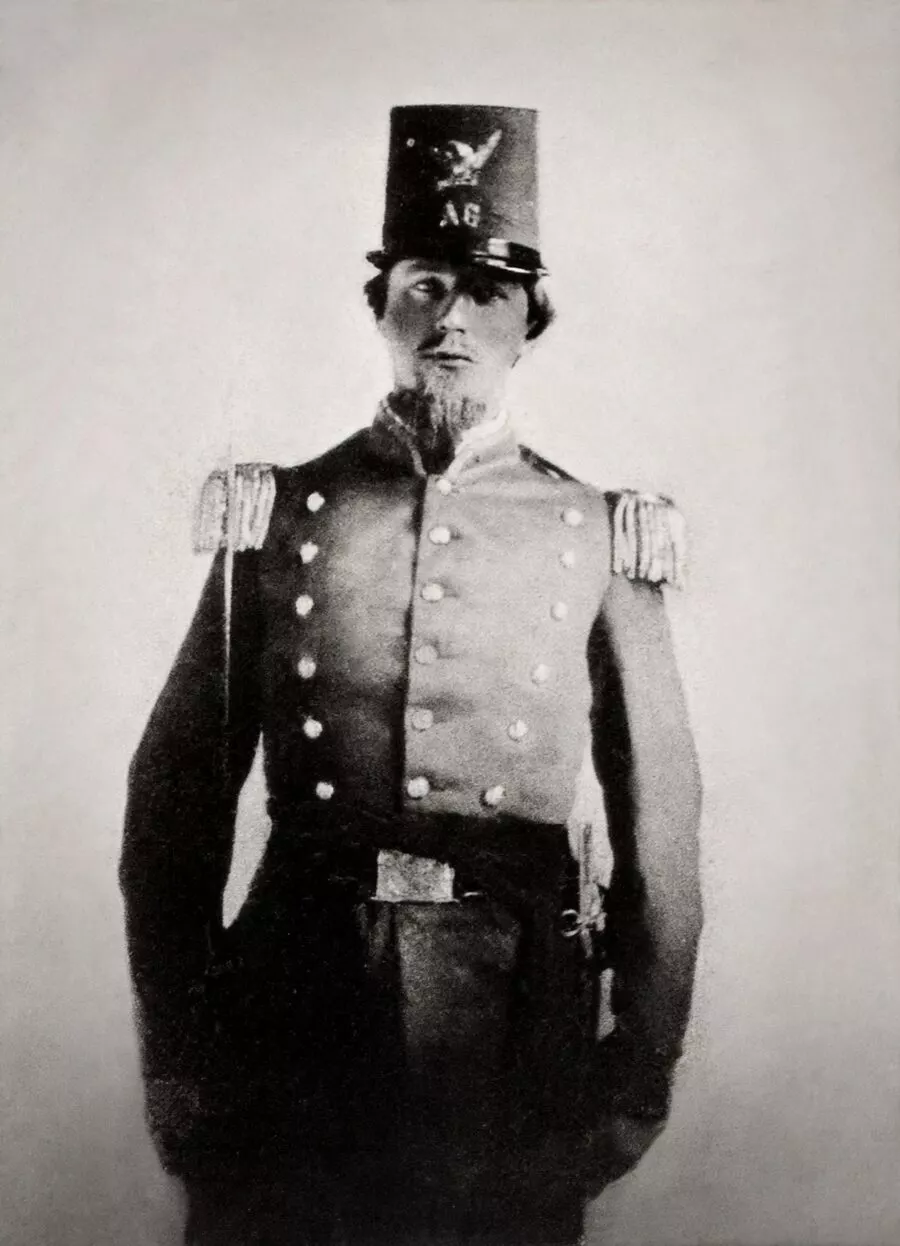
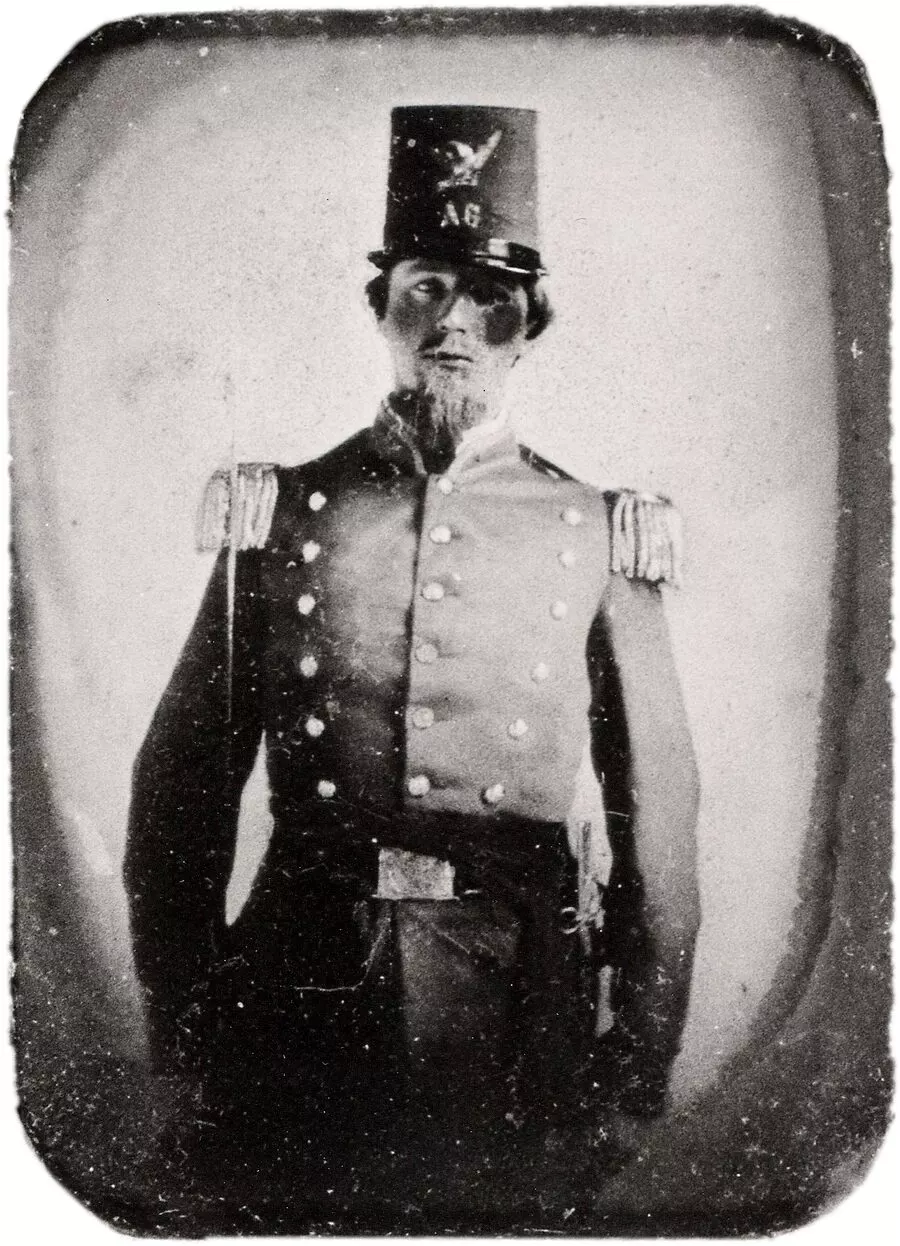
It cleared the specks and evened out the background. It did not invent a sharp new face: his was soft on the plate and it stayed soft, smudge and all. It also squared off the plate's rounded corners, so keep your scan too. Where a face is too damaged to read, the AI has to guess, so check it against the original.
Lots of these cased portraits show men in uniform. If yours does, our guide to old military photos helps you label it. And if a plate ever gets wet, don't freeze it the way you might a soaked print; see what to do with water-damaged photos.
You can try the restorer free without an account, up to two photos a day. Free results are a watermarked preview, fine for checking the repair; clean full-size downloads come with a paid plan.
Clean up your scan
Upload the copy, choose Restore only, and compare it with the plate. Try it free; clean downloads are on paid plans.
Quick questions
Is a tintype made of tin?
No. It's a thin sheet of iron with a dark coating, which is why a magnet sticks to it. The name just stuck.
What's the difference between an ambrotype and a tintype?
An ambrotype is on glass, with a dark backing that makes the image look positive. A tintype is on iron. They can look alike in a case, so try a magnet: it clings to a tintype and does nothing to glass.
Can I scan a daguerreotype?
Not on a flatbed: the mirror surface throws the scanner's light back and the picture washes out. Photograph it in its case with lights low at the sides and a black card around your lens.
How old is a tintype?
Anywhere from the 1850s into the 1930s, so the plate alone won't date it closely. Clothes, the case and the photographer's stamp narrow it down.
Images: daguerreotype Margaret Fuller by John Plumbe Jr., 1846, National Portrait Gallery, Smithsonian, CC0. Tintype “Unidentified soldier in uniform with young girl” and ambrotype “Unidentified African American woman”, Liljenquist Family Collection, Library of Congress, no known restrictions on publication. Captain Dandridge McRae, about 1860, Prairie Grove Battlefield State Park, public domain, restored by us. Crops and the simulated negative: ours. The tilt, magnet and backing videos are built from these museum photos; the 3D cases, stands, lamp, magnet, mirror reflection and the ambrotype's negative view, backing card and flake are simulated by us.
Try it on one of your own photos
Most of our photo tools have a free version. Upload a picture and see what it does before you decide anything.